Nathan Lee
Computer Studies 10

Timeline
Timeline of the Final Animation project set in 1876 during the Indian Act.
Green is finished
Tan is in progress
White is not in progress
Script
Story of the movie. Scenes 1, 2, 6, and 7, are Nathan's. Scenes 3, 4, 5, and 8 are Julia's.
Scene1: Begins with Aditsan opening the door to visit his grandmother, Nagamo, who is in the living room. After greeting each other, Aditsan inquires about some vintage pictures that were framed he had not seen before, each one depicting past events of their tribe. Solemnly, Nagamo gestures to the pictures, stating that these came from when the Indian Act was first introduced, a time when their rights were stripped away under the threat of violence and imprisonment to erase the First Nations’ identity and exploit their lands.
Scene2: (Camera moves to the top left picture and zooms in with a transition fade to black. Camera zooms out from a fireplace displaying a night pow wow. (Nagamo) I will always remember the night of April 12, 1876. At the time, I was just a little girl sitting on the outskirts of the campfire, observing our people performing one of our beautiful traditional dances. However, this would be the last time we danced, as that night was when the Indian Act was signed. As a result, the government had sent out rangers to all the tribes in order to prohibit our traditional dances and inform us of the new laws. When they came, their captain fired their gun into the sky, and there was a great silence. They called upon our chief in order to tell him of the new rules that were being enforced. After this confrontation, the rangers left, leaving behind great sadness and frustration within the tribe. (Aditsan) But why did the chief agree to just let go of our most sacred traditions without any objections? (Nagamo) Our chief did so with the tribe’s safety and survival in mind. He knew that if he did not follow these new rules as the rest of the tribes, the Canadian Government would do everything in its power to oppress us into submission and make an example of us.
Scene3: Aditsan is shocked after learning this information. Aditsan loved his culture, and the thought of it being stripped away terrified him. Knowing that his grandmother and his people at the time weren’t allowed to express themselves made him realize how lucky he is that most of the racist laws were removed. (Aditsan) Why did they call it the Indian act? We aren’t even Indian, we are the First Nations! (Nagamo) Well, they just assumed we were Indian because of our skin colour. They didn’t want to listen to reason when we told them that we were First Nations. Unfortunately, their greed and selfishness for prospects of new lands to plunder and take blinded their moral views of humanity. Initially they came with peaceful intentions, being willing to trade and co-habit the lands as equals, which they used as leverage to create the Indian Act, a guise to subjugate and steal the lands that we have lived on and taken care of for time immemorial
Scene4: (Nagamo) *sighs* I remember I would go to bed hoping that this nightmare would end. Hoping that everything would go back to normal when we were free, living in the ways of our ancestors without any opposing influences. All those sleepless nights when I woke up in cold sweat were because I was so scared of what tomorrow would bring. (Aditsan) I can‘t even begin to imagine
Scene5: (Nagamo) When I was about your age, Aditsan, I was sent to an institution called residential school. Aditsan, I wished I had never ever set foot in them. The horrors I was forced to bear witness to within those nightmarish hallways, I wish I could forget. These were no “schools”; these places were meant to break us, dehumanize us, and kill us. (Aditsan) Didn’t the people outside know about the awful things that were happening? Why weren’t these places shut down earlier? (Nagamo) Well, these schools were funded by the Canadian Government and run by their churches; we were powerless to do anything against the System
Scene6: (Camera pans over the previous pictures now in lower opacity) 75 years, 75 long years of tragedy after tragedy, the unjust oppression that we endured, the unnecessary violence, all because we were different and they were greedy for our rich lands. In recent years, the Canadian Government has been trying to make amends for the past. We finally started seeing some ending of the restrictions that were placed on us all those decades ago. I remember being in that room when they signed the revisions. Our people were dancing and rejoicing, press cameras flashing everywhere, smiles on our people’s faces, and tears of bitterness and happiness were shed. (zoom out from left with fade out from right, both towards middle, final zoom out from agreement signed) Finally, we regained the right to perform our own traditional rites, when we should have never been prohibited to do so in the first place.
Scene7: (uses BG1 but draw something WWI/WWII + Indigenous related) (Nagamo) *sighs* We’re finally having consistent talks with the Government now. Back then when we tried to make appeals, they just ignored, threatened, or imprisoned us. But because of WWI and WWII, we as a people were given an opportunity to prove ourselves as equals to our Canadian counterparts, which opened their eyes and ears to the things that we were capable of. Although change will be slow, we are making strides towards a better Canada for us all.
Scene8: (Camera pans and zooms between these things) Drawn summary of things that have been mended between Indigenous peoples and the Canadian Government.
Character 1: Nagamo
The 1st Character, Nagamo the grandmother and the 2nd character is a soldier.


Backgrounds for scenes
The 1st background.

The 6th background.

The 7th background.

The 2nd background.


Storyboards
The 1st storyboard.


The 2nd storyboard.


The 3rd storyboard.
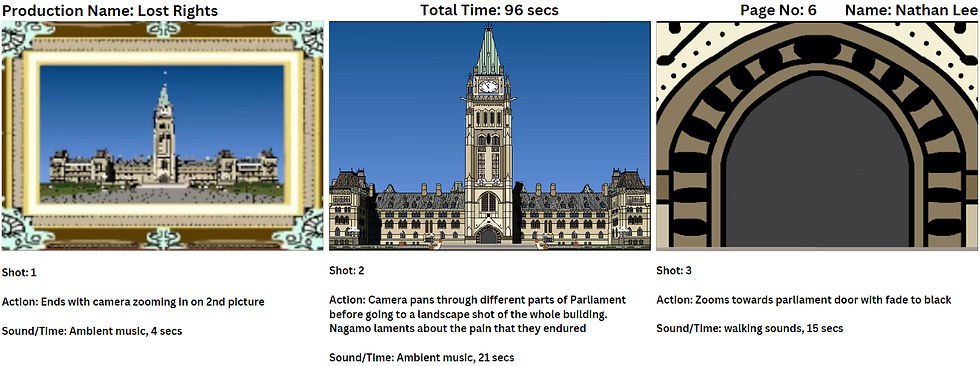

The 4th storyboard.


